
Starting a business is one thing. Convincing other people to believe in it is something else entirely.
Whether you’re trying to raise money, win a client, secure a grant, or build a partnership, there will come a point when you need to present your idea clearly. That’s where a pitch deck comes in.
A pitch deck is simply a presentation that helps you explain your business, product, service, or proposal to a specific audience. The goal isn’t always the same. Sometimes you’re asking for funding. Sometimes you’re trying to close a sale. Other times, you’re looking for support, collaboration, or approval.
That is why there isn’t just one type of pitch deck.
Different situations call for different presentations. Knowing which type to use can make a huge difference in how your message is received.
Let’s look at the most common pitch decks every small business owner should know about.
7 Types of Pitch Decks
Here’s a closer look at the different types of pitch decks:
1. Investor Pitch Deck
Purpose: To secure funding from investors.
Focus: Business opportunity, growth potential, financial returns, and scalability.
An investor pitch deck is designed to answer one important question: Why should someone invest money in your business?
This type of deck typically introduces the problem you’re solving, your solution, target market, business model, competitive advantage, and financial projections. Investors also want to understand your team and why you are the right people to execute the idea.
The goal is not to explain every detail of your business. Instead, it is to create enough confidence that investors want to continue the conversation.
A strong investor deck focuses on opportunity, market potential, and long-term growth.
2. Startup Pitch Deck
Purpose: To introduce a new business or startup concept.
Focus: Vision, product, market opportunity, and future plans.
Startup pitch decks are often used during the early stages of a business. While they may sometimes be presented to investors, they can also be used for incubators, accelerators, competitions, and networking opportunities.
This presentation usually highlights the problem being addressed, the solution being offered, the target audience, and the overall vision behind the company.
Since startups often have limited financial history, the emphasis is usually placed on innovation, market demand, and future potential rather than extensive performance data.
A startup pitch deck should leave people excited about where the business is heading.
3. Sales Pitch Deck
Purpose: To convince prospects to purchase a product or service.
Focus: Customer challenges, benefits, solutions, and outcomes.
A sales pitch deck is one of the most commonly used presentations in business.
Unlike investor presentations, which focus on company growth, sales decks focus entirely on the customer. The presentation should demonstrate that you understand the prospect’s problem and have a solution that can help.
Effective sales decks often include customer pain points, product benefits, case studies, testimonials, pricing information, and expected results.
The objective is simple. Move the prospect closer to making a buying decision.
The clearer the value proposition, the stronger the sales presentation becomes.
4. Partnership Pitch Deck
Purpose: To establish strategic partnerships and collaborations.
Focus: Mutual benefits, shared goals, and collaboration opportunities.
Businesses rarely grow in isolation. Partnerships often help companies reach new markets, improve services, or strengthen their brand.
A partnership pitch deck explains why two organizations should work together.
This type of presentation typically outlines the proposed partnership, expected benefits, responsibilities, business alignment, and potential outcomes for both parties.
The most successful partnership decks focus on shared value rather than one-sided gains.
When both sides can clearly see the opportunity, partnerships become much easier to build.
5. Grant Proposal Pitch Deck
Purpose: To secure grant funding from organizations, institutions, or government programs.
Focus: Impact, objectives, implementation plan, and measurable results.
Grant providers are often looking for projects that solve problems or create positive outcomes.
A grant proposal pitch deck should clearly explain the issue being addressed, the proposed solution, the target audience, project timeline, budget requirements, and expected impact.
Unlike investor presentations, grant decks usually place less emphasis on profitability and more emphasis on outcomes and measurable benefits.
The goal is to demonstrate that the funding will be used responsibly and generate meaningful results.
Clarity and credibility are especially important in this type of presentation.
6. Demo Pitch Deck
Purpose: To showcase how a product works.
Focus: Features, functionality, user experience, and practical use cases.
Sometimes people do not need more explanations. They simply need to see the product in action.
That is where a demo pitch deck becomes valuable.
A demo deck walks the audience through the product experience and demonstrates how it solves a specific problem. Screenshots, workflows, live demonstrations, and product examples are often included.
The presentation should focus on real-world usage rather than technical complexity.
People want to understand how the product helps them, not necessarily how it was built.
A good demo deck makes the product feel easy to understand and easy to adopt.
7. Customer Pitch Deck
Purpose: To build trust and convert potential customers.
Focus: Customer needs, value proposition, proof, and results.
While sales decks and customer pitch decks may seem similar, customer decks are often more personalized.
These presentations are usually tailored to a specific customer or client. They address unique challenges, goals, and expectations while showing how your product or service can deliver results.
Customer pitch decks often include industry-specific examples, customized recommendations, implementation plans, and success stories.
The focus remains on the customer’s situation rather than your company.
When prospects feel understood, they are more likely to move forward.
Create a Professional Pitch Deck with SlidesAI
Most small business owners don’t struggle with the idea. They struggle with the presentation.
A pitch deck needs to look polished, tell a clear story, and make your audience pay attention from the first slide to the last. Hiring designers or presentation specialists can quickly become expensive, and building a deck from scratch often takes far more time than expected.
That’s where SlidesAI can help.
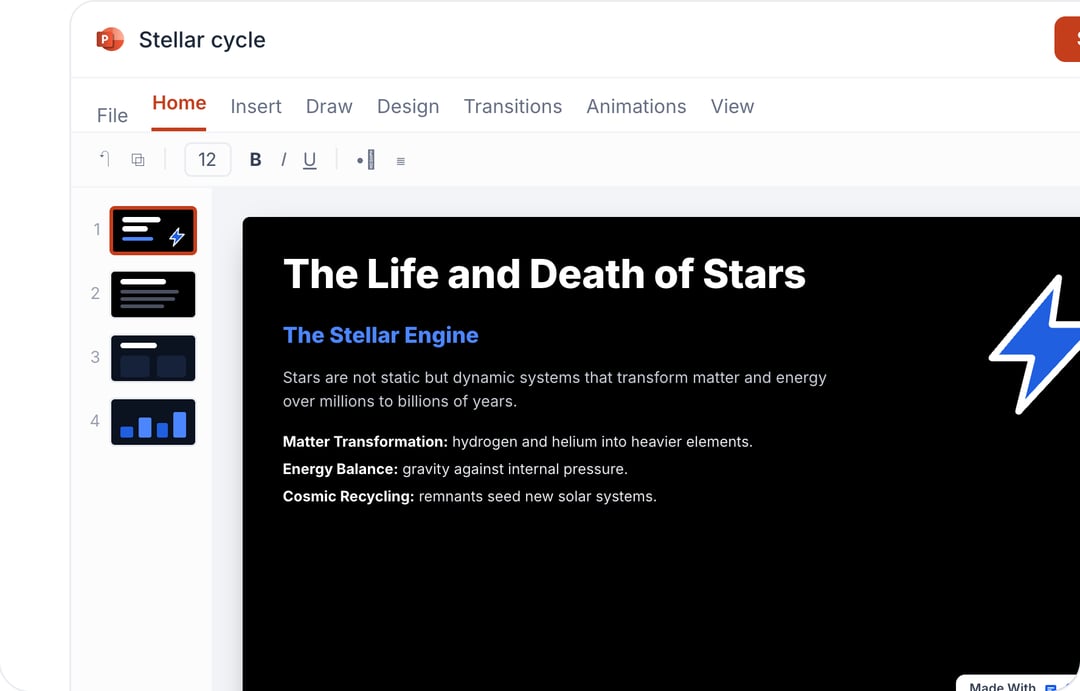
SlidesAI can work as an AI pitch deck generator that helps you create professional presentations without spending countless hours writing content, designing slides, or formatting layouts. It works seamlessly with Google Slides and PowerPoint, making collaboration simple and eliminating the need for additional software.
Instead of starting with a blank slide, SlidesAI helps you move from idea to presentation much faster. From generating an outline to creating content and designing slides, the platform handles much of the heavy lifting.
Here’s how it works:
Step 1: Install and Set Up
Open Google Slides or PowerPoint, install the SlidesAI add-on, and log in to your account.
Step 2: Start a New Presentation
Navigate to Extensions/ Add-in> SlidesAI > Generate New Slides and enter your presentation topic.
Step 3: Set Your Preferences
Choose your presentation type, audience, tone, and language. You can also add additional instructions to guide the content generation process.
Step 4: Choose Your Design
Select from available presentation templates. You can add your company logo and choose whether you want AI-generated visuals or stock photos included in your slides.
Step 5: Review the Outline
SlidesAI generates an outline before creating the full presentation. Review it carefully and make any changes you want.
Step 6: Generate and Review Your Slides
Once the outline is approved, SlidesAI creates the complete presentation. Review the final slides, make any adjustments, and get ready to present.
Take Your PowerPoint From Basic to Professional With SlidesAI
- Improve your slide content with AI
- Create polished layouts faster
- Work directly inside PowerPoint

SlidesAI Also Offers Ready-to-Use Pitch Deck Templates
Not every presentation needs to start from scratch.
SlidesAI also provides professionally designed pitch deck templates that can help you build presentations faster while maintaining a polished and consistent appearance. Whether you’re preparing for investors, partnerships, fundraising campaigns, or grant applications, these templates provide a strong starting point and help you focus more on your message than slide design.
- Investment Proposal Pitch Deck Template
- Business Proposal Pitch Deck Template
- Business Pitch Deck Template
- Fundraising Event Pitch Deck Template
- Grant Proposal Pitch Deck Template
Final Thoughts
The best pitch deck is not always the most beautiful one. It is the one that helps your audience quickly understand what you are offering and why it matters.
Whether you’re raising capital, closing a sale, applying for funding, or building partnerships, choosing the right type of pitch deck can make your presentation more focused and persuasive.
Once you know your audience and your objective, creating a deck becomes much easier. The rest comes down to telling a clear story and presenting it with confidence.