
Science touches everyday life more than most people realize. In fact, 72% of U.S. adults say science benefits them personally, from healthcare advances to modern technology. As a result, science communication has become a critical skill across classrooms, laboratories, and workplaces.
Yet many presenters struggle with one core challenge: choosing science topics for presentation that are accurate, engaging, and appropriate for their audience. Topics that are too technical can confuse listeners, while overly simplified ones risk losing credibility.
This guide solves that problem by offering a curated list of science presentation topics, organized by audience level and context. It also includes format strategies, common pitfalls, and practical guidance for turning complex scientific ideas into clear, visual stories.
Trending Science Topics for Presentation in 2026
Science presentations in 2026 reflect rapid advances in technology, healthcare, and environmental
research. The following topics consistently attract interest across academic and professional
settings.
- Quantum Computing and Cryptography
This topic explores how quantum systems process information differently from classical computers and what that means for data security and encryption. - Climate Change Mitigation Strategies
Climate change strategies focus on renewable energy, carbon capture, and policy-driven solutions. They are aimed at reducing climate impact rather than just explaining climate change. - AI in Medical Diagnostics
AI in medical diagnostics is one of the most interesting science topics for presentation. It covers how artificial intelligence supports early disease detection, medical imaging, and clinical decision-making without replacing human judgment. - Dark Matter and Energy Mysteries
Dark matter presentations examine the unseen forces shaping the universe and why scientists still struggle to explain most of its mass and expansion.
Best Science Topics for Presentation by Audience and Education Level
The best topics for science presentations depend heavily on who is listening. Age, background knowledge, and learning goals all influence how your message is received.
Science Topics for Middle School Students (Grades 6–8)
Middle school science presentation topics should be simple, visual, and grounded in everyday observation.
- What is a planet?
- Why do we have day and night?
- Why the Moon changes shape
- What are shooting stars?
- What makes Earth unique?
- How many moons do planets have?
- Why stars look small but are huge
- What is the Milky Way?
- What are comets made of?
- Why do seasons change?
- How does gravity work?
- What makes the Sun a star?
- Why Mars is called the Red Planet
- What is the International Space Station?
- How astronauts sleep in space
- What are constellations?
- Why the sky is blue
- What happens during a solar eclipse?
- Why do we have tides?
- How rockets launch into space
- What is a galaxy?
- What is a black hole?
- How robots are used in space missions
- How Earth rotates and revolves
- The North Star and why it matters
- How scientists discover distant planets
You can create a science PowerPoint with AI to present scientific data, theories, discoveries, and case studies in a more engaging and understandable format.
Science Topics for High School Students (Grades 9–12)
High school audiences benefit from curiosity-driven topics that connect core science concepts with astronomy, space, and observable phenomena.
- What makes a planet a planet?
- Why Pluto is no longer considered a major planet
- How the Sun, Moon, and stars move across the sky
- Why do seasons change on Earth?
- What makes outer planets different from inner planets
- The life cycle of stars
- Black holes: what we know and don’t know
- Dark matter and dark energy
- How galaxies form and collide
- The search for exoplanets
- Could humans ever live on Mars?
- Comets, asteroids, and dwarf planets
- What causes solar and lunar eclipses?
- Jupiter’s Great Red Spot
- How telescopes changed astronomy
- The science behind meteor showers
- How gravity shapes the universe
- What makes Earth habitable?
- The future of space exploration
- Time dilation and relativity
- How space weather affects Earth
- The search for extraterrestrial life
- Why the universe is expanding
- The Milky Way: our cosmic home
- How satellites work
- The fate of the universe
Science Topics for College and University Students
College-level science topics for presentation require deeper analysis, ethical considerations, and future implications.
- Quantum computing and future applications
- CRISPR gene editing ethics
- Nanotechnology in medicine
- AI in scientific research
- Machine learning in healthcare diagnostics
- Renewable energy innovations
- Neuroscience of memory formation
- The human microbiome
- Climate modeling systems
- Stem cell therapy advancements
- Graphene and advanced materials
- Biotechnology in agriculture
- Genetic engineering in food
- Cybersecurity in scientific data
- Space colonization pathways
- Dark matter detection experiments
- Protein folding and AI
- Quantum entanglement
- Ethics of AI-driven science
- Environmental toxicology
- Human-computer interaction in science
- Biomedical implants
- Oceanography and deep-sea exploration
- Advanced robotics in medicine
- Brain-computer interfaces
- The future of personalized medicine
Read in detail – Top Presentation Topics for Students
Science Topics for Professional and Academic Audiences
These science topics for presentation are best suited for conferences, research forums, and industry discussions.
- Antibiotic resistance
- Gene therapy for inherited diseases
- Precision oncology
- Nanomaterials in biomedical engineering
- CRISPR in large-scale agriculture
- Dark energy and cosmic expansion
- AI in climate science
- Quantum physics in cybersecurity
- Neural networks in robotics
- Renewable energy infrastructure
- Bioinformatics in genetics
- Ethics of human cloning research
- Planetary protection protocols
- AI-driven drug discovery
- Biodiversity loss mitigation
- Microplastics in marine ecosystems
- Neuroscience of consciousness
- Hawking radiation
- Cryo-electron microscopy
- Next-generation battery science
- Climate geoengineering
- Advanced space propulsion
- Pandemic modeling systems
- Environmental DNA (eDNA)
- Fusion energy breakthroughs
- Ethical frameworks for emerging technologies
“Create engaging science presentations faster with our collection of presentation templates.”
Presentation Format Strategies
Different science topics work best with specific presentation formats.
- Interactive Demonstrations
Hands-on experiments and simulations enhance understanding, particularly for concepts in physics and chemistry. - Data Visualization Techniques
Charts, diagrams, and animations help audiences quickly interpret complex datasets. - Storytelling Approaches
Narratives connect scientific discovery to human impact, making abstract ideas relatable. - Debate and Discussion Formats
Debates and discussions work well for ethical, environmental, and policy-driven science topics.
Turn your science topic into slides instantly — try our ChatGPT presentation maker.
Common Science Presentation Pitfalls to Avoid
It’s critical to be aware of the mistakes you should avoid when presenting science topics. Some of the most common ones are as follows:
- Overloading With Technical Jargon: Too much terminology reduces comprehension and engagement.
- Poor Visual Hierarchy: Cluttered slides distract from key ideas.
- Ignoring Audience Knowledge Level: Misaligned complexity leads to confusion or disengagement.
- Inadequate Practice Time: Even strong content suffers without rehearsal.
Learn More about “Common Presentations Mistakes To Avoid“
Why SlidesAI Works Well for Science Presentations?
SlidesAI allows you to quickly turn an outline or set of notes into a logical slide structure with clear headings and key points. This helps ensure that your presentation follows a natural flow, even for complex scientific topics.
- Instant Outline-to-Slide Conversion: Paste your science topic or notes, and SlidesAI automatically creates a logical slide structure with clear headings and key points.
- Clean, Readable Slide Design: Science presentations benefit from clarity. SlidesAI uses simple layouts that improve readability and reduce cognitive overload.
- Support for Data-Heavy Content: SlidesAI helps organize charts, diagrams, and key findings so that complex information is easier to understand.
- Audience-Ready Customization: Slides can be quickly adapted for school, college, or professional audiences without rebuilding the presentation from scratch.
- Works With Familiar Tools: SlidesAI integrates directly with Google Slides and PowerPoint, keeping workflows simple for students, educators, and professionals.
Create Presentations in Minutes With SlidesAI
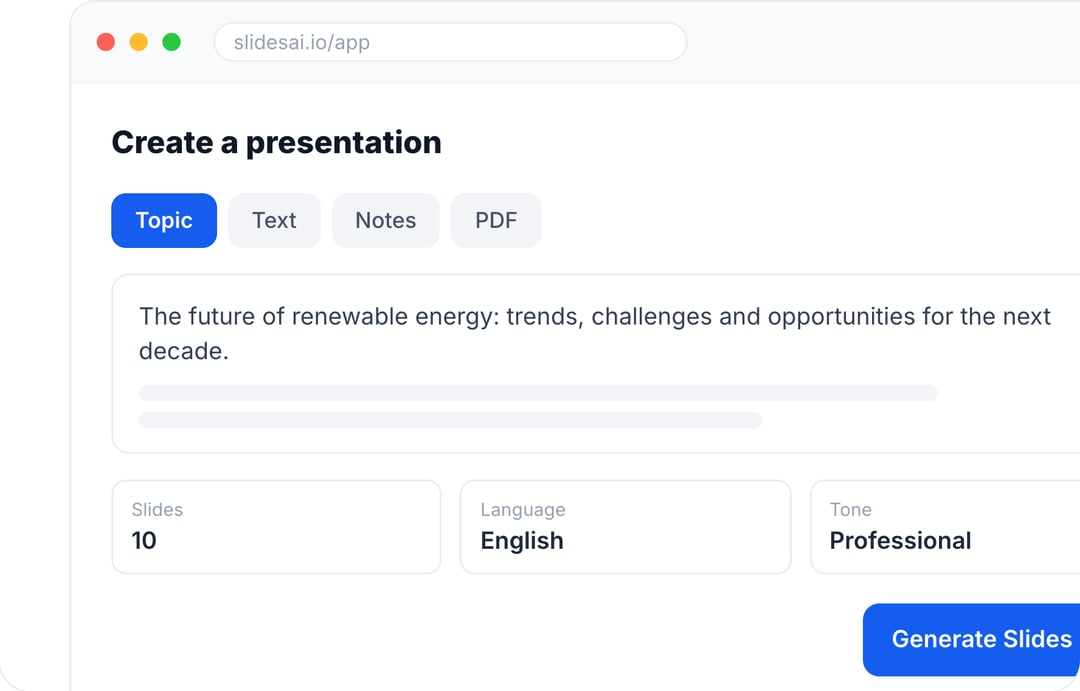
- Start with a topic, text, notes, or PDF
- Generate slides in minutes
- Customize your presentation with ease
Final Thoughts
Choosing the right science topics for presentation can transform how your audience understands and remembers your message. Whether you are speaking to middle school students or professional researchers, the most effective presentations balance accuracy, relevance, and clarity.
With science communication becoming increasingly visual and fast-paced, tools like SlidesAI help bridge the gap between strong ideas and effective delivery. By combining the right topic with clean structure and smart visuals, you can create presentations that inform, engage, and inspire.
Whether you’re a student preparing for class, a professional gearing up for a boardroom pitch, or just someone who got voluntold to present — we’ve got topic ideas tailored for you. Great presentations don’t happen by accident; they start with a topic that fits the moment. Browse our full collection below and find the one that’s right for you.
- 250+ Best Presentation Topics from Different Categories & Useful Tips
- Best 5-Minute Presentation Ideas: Topics, Tips & How to Pick One
- 125+ Impromptu Presentation Topics for Students, Professionals, & More
- 400+ Funny PowerPoint Night Ideas to Steal The Show
- Best Leadership Topics for Presentation
- 10 Minute Presentation Ideas: Best Topics, Examples & Tips
- 200+ Persuasive Presentation Topics, Examples & Structure
FAQs
1. Which is the best topic for a science presentation?
The best science topic for a presentation is one that matches your audience’s knowledge level and connects scientific concepts to real-life impact. Topics that explain why something matters, not just how it works, are usually more engaging and effective.
2. How do I choose a science topic for a high school presentation?
Choose topics that build on what students already know while adding curiosity. Astronomy, space science, climate change, and human biology work well because they are visual, relatable, and easy to explain without heavy technical language.
3. What are the most interesting science topics for presentation to middle school students?
Middle school students respond best to topics like planets, gravity, weather, ecosystems, robots, and basic physics concepts. These subjects are concrete, visual, and easy to connect to everyday experiences.
4. What are the best science topics for a presentation for college students?
College students engage more with topics such as artificial intelligence in research, renewable energy innovations, CRISPR gene editing, neuroscience, climate modeling, and ethical issues in emerging technologies.
5. What are some unique ideas for science presentations?
Unique science presentation topics include dark energy, fusion power, brain-computer interfaces, environmental DNA tracking, microbiomes, quantum cryptography, and advanced space propulsion technologies.
6. How can I make complex science topics understandable for non-experts?
Focus on one main idea supported by two or three key points. Use analogies, visuals, and everyday examples, and avoid unnecessary jargon. Explain new terms only when needed.
7. How do I structure a science presentation for maximum impact?
A strong structure starts with the topic and why it matters, followed by the core concept, a real-world example or application, and a clear takeaway. This flow helps audiences follow and remember your message.
8. How can I make my science presentation stand out from others?
Prioritize clarity over complexity. Use clean visuals, choose a strong angle, and connect your topic to a real-world question or problem. Presentations stand out when they make science easier to understand.