
A great presentation is rarely about fancy animations or beautiful graphics. Most successful decks work because the information is organized in a way that makes sense to the audience. Whether you’re pitching investors, presenting a business strategy, or running a workshop, the structure of your slides often determines whether people stay engaged or lose interest. In this guide, we’ll break down proven slide structures for investor pitch decks, strategy presentations, and workshop presentations, along with what should go into each slide.
Investor Pitch Deck Structure
Investor presentations have one goal: convince investors that your company is worth backing. While every startup is different, most successful pitch decks follow a similar flow.
Slide 1: Cover / Title Slide
This is your first impression.
Include:
- Company name
- Logo
- Tagline
- Presenter name and title
- Contact information
Keep it simple. Think about Airbnb’s famous pitch deck. Their opening slide immediately communicated what the company did without overwhelming investors with information.
Slide 2: Problem Slide
Investors need to understand the problem before they can appreciate your solution.
Include:
- The challenge customers face
- Data supporting the problem
- Real-world examples
For example, Airbnb highlighted how booking affordable accommodation was difficult and inconvenient for travelers. The problem was easy to understand and relatable.
Slide 3: The Solution Slide
Now show how your product solves the problem.
Include:
- Product overview
- How it works
- Benefits to users
- Visual demonstration if possible
Focus on outcomes rather than features. Investors care about the value being created.
Slide 4: Why Now
Timing matters.
Even great ideas can fail if the market is not ready.
Include:
- Industry shifts
- Technology advancements
- Consumer behavior changes
- Market trends
Uber benefited from widespread smartphone adoption. Without smartphones, their business model would have been much harder to scale.
Slide 5: Market Size
Investors want to know how big the opportunity is.
Include:
- Total Addressable Market (TAM)
- Serviceable Available Market (SAM)
- Serviceable Obtainable Market (SOM)
Avoid unrealistic numbers. Show a clear path from today’s market opportunity to future growth.
Slide 6: Product
This slide focuses on what you’ve built.
Include:
- Product screenshots
- Core features
- User journey
- Differentiators
Dropbox’s early pitch deck used simple visuals to explain a product that could otherwise seem technical.
Slide 7: Market Validation
Investors want proof.
Include:
- Customer growth
- Revenue growth
- User testimonials
- Retention metrics
- Partnerships
Even small wins matter. Showing traction reduces perceived risk.
Slide 8: Business Model
Explain how you make money.
Include:
- Pricing structure
- Revenue streams
- Customer lifetime value
- Subscription or transaction model
The simpler this slide feels, the better.
Slide 9: Go-To-Market Strategy
How will you acquire customers?
Include:
- Marketing channels
- Sales strategy
- Partnerships
- Customer acquisition approach
Show that growth is intentional rather than accidental.
Slide 10: Competition
Every company has competitors.
Include:
- Competitor comparison matrix
- Market positioning
- Unique advantages
Avoid claiming you have no competition. Investors usually see that as a red flag.
Slide 11: Team
Investors often invest in people as much as ideas.
Include:
- Founders
- Leadership team
- Relevant experience
- Notable achievements
Highlight why your team is uniquely positioned to solve this problem.
Slide 12: The Ask
Finish with clarity.
Include:
- Funding amount
- Use of funds
- Growth objectives
- Future milestones
Make it easy for investors to understand exactly what you need and why.
Slide Structure for Strategy Presentations
Strategy presentations help teams align around a vision and execution plan. They are commonly used by leadership teams, department heads, and consultants.
Slide 1: Title Slide
Include:
- Strategy title
- Company or department name
- Presenter information
- Date
Keep the opening clean and professional.
Slide 2: Executive Summary & Big Idea
Start with the most important message.
Include:
- Strategic goal
- Expected business impact
- High-level recommendations
If someone only sees this slide, they should still understand the direction being proposed.
Slide 3: Mission and Vision
Provide context for the strategy.
Include:
- Company mission
- Long-term vision
- Strategic priorities
This reminds stakeholders why the strategy exists in the first place.
Slide 4: Current Situation / SWOT Analysis
Explain where the organization stands today.
Include:
- Strengths
- Weaknesses
- Opportunities
- Threats
- Supporting data
A SWOT analysis helps connect current realities with future plans.
Slide 5: Strategic Initiatives (The How)
This is the heart of the presentation.
Include:
- Major initiatives
- Strategic pillars
- Business priorities
- Expected outcomes
Break large goals into actionable focus areas.
Slide 6: Execution Plan & Timeline
A strategy without execution is just an idea.
Include:
- Roadmap
- Milestones
- Timeline
- Ownership responsibilities
Visual timelines often work well here.
Slide 7: KPIs & Resources
Show how success will be measured.
Include:
- Key performance indicators
- Budget requirements
- Team resources
- Technology needs
Stakeholders need to understand both expectations and requirements.
Slide 8: Conclusion
Wrap everything together.
Include:
- Summary of priorities
- Expected results
- Next steps
For social media strategy presentations, you can also use ready-made templates such as the Social Media Strategy Presentation Template from SlidesAI to speed up the process and maintain a professional structure.
Slide Structure for Workshop Presentations
Workshops are different from traditional presentations because participation matters just as much as information.
Slide 1: Title Slide
Include:
- Workshop title
- Facilitator name
- Date
- Organization name
Set the tone immediately.
Slide 2: Pain Point / Hook
Capture attention early.
Include:
- Surprising statistic
- Common challenge
- Thought-provoking question
- Real-world example
Give participants a reason to care.
Slide 3: Why This Matters
Explain the value of the session.
Include:
- Benefits of learning the topic
- Business impact
- Personal relevance
Participants should understand why they should stay engaged.
Slide 4: Agenda & Objectives
Set expectations.
Include:
- Session agenda
- Learning goals
- Activities
- Expected outcomes
This helps participants mentally prepare for the session.
Slide 5: Theories & Frameworks
Introduce foundational concepts.
Include:
- Models
- Frameworks
- Best practices
- Visual diagrams
Keep theory practical and easy to apply.
Slide 6: Case Studies
People learn better through examples.
Include:
- Success stories
- Real-world applications
- Lessons learned
- Before-and-after comparisons
Case studies help bridge theory and practice.
Slide 7: Activity Instructions
Clearly explain participant exercises.
Include:
- Activity objective
- Instructions
- Time allocation
- Expected output
Avoid confusion by being specific.
Slide 8: Blank / Discussion Slides
Leave room for interaction.
Include:
- Reflection questions
- Group discussion prompts
- Brainstorming exercises
These slides encourage active participation rather than passive listening.
Slide 9: Key Takeaways
Reinforce learning.
Include:
- Main lessons
- Framework summaries
- Practical actions
Participants should leave with clear insights.
Slide 10: Call to Action (CTA)
Help participants apply what they’ve learned.
Include:
- Next steps
- Resources
- Recommended actions
- Follow-up activities
Turn learning into implementation.
Slide 11: Q&A & Contact
End on an open note.
Include:
- Contact details
- LinkedIn profile
- Website
- Questions section
This creates opportunities for continued engagement after the workshop.
How You Can Create These Decks in SlidesAI?
Building presentations slide by slide can take hours. Research, content organization, formatting, and design often consume more time than the actual message you’re trying to deliver.
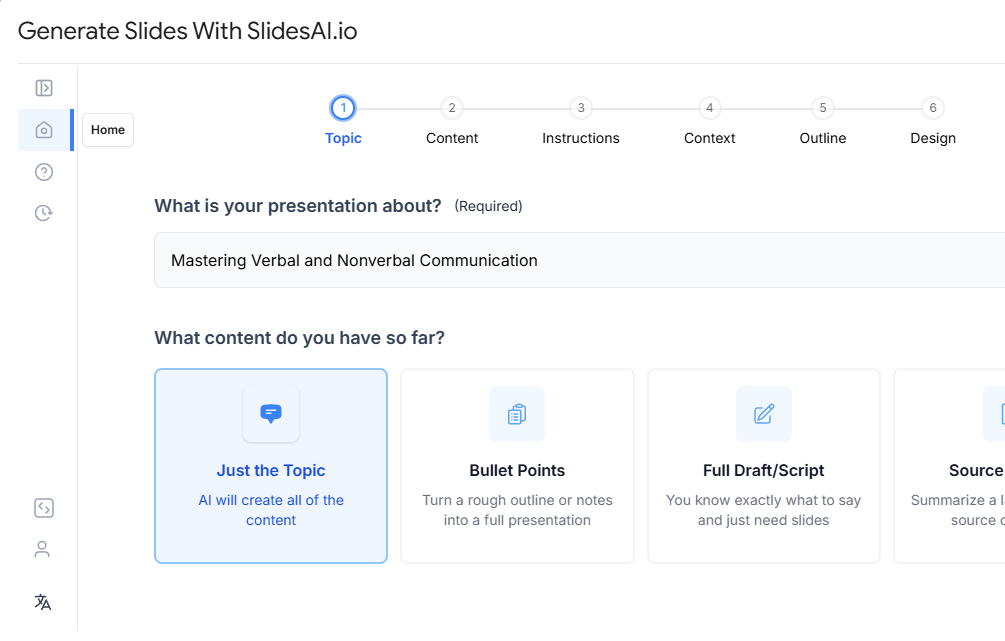
SlidesAI helps simplify that process.
Instead of starting with a blank presentation, you can generate complete decks from a prompt, topic, document, or outline. Whether you’re preparing an investor pitch, strategy presentation, workshop deck, or marketing plan, SlidesAI can create a structured presentation within minutes.
Some useful SlidesAI features include:
- AI-powered presentation generation
- Pre-designed presentation templates
- Automatic slide structure suggestions
- Custom themes and branding
- AI image generation
- Multi-language support
- Smart content formatting
- Presentation summarization
- Quick editing and refinement tools
Rather than spending hours arranging content, you can focus more on your message, audience, and delivery.
Create Presentations Easily in Google Slides and PowerPoint
- No design skills required
- 3 presentations/month free
- Don't need to learn a new software

Closing Thoughts
The best presentations follow a clear structure. Investor decks guide investors through opportunity and growth potential. Strategy presentations align teams around goals and execution. Workshop presentations help participants learn, engage, and take action.
Once you understand the purpose of each slide, creating presentations becomes much easier. And with tools like SlidesAI, you can turn ideas into professional presentations in minutes without starting from scratch every single time.