
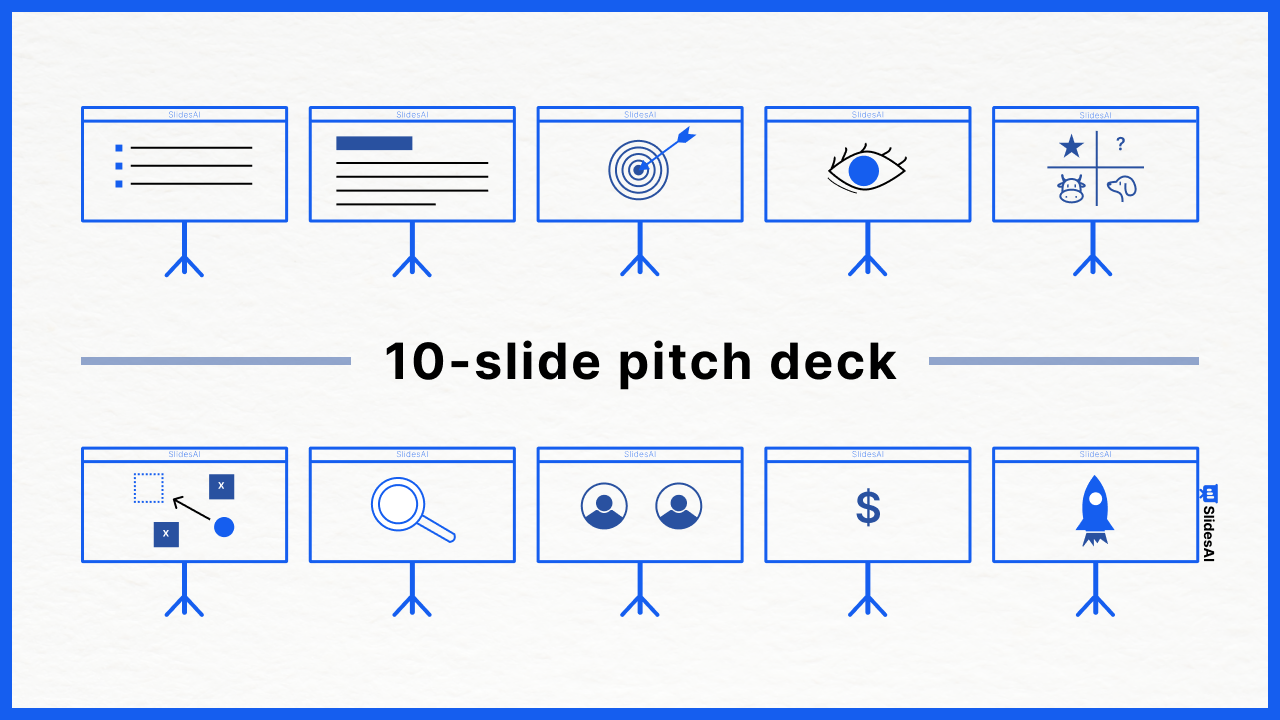
Creating a pitch deck can feel a little overwhelming when you are doing it for the first time. There are numbers to explain, a business idea to sell, competitors to talk about, and probably a lot more information than you can fit into a few slides. In this blog, we will walk you through what a pitch deck is, the different types you can create, what to include in each slide, and how you can use SlidesAI to put one together. Let’s get started.
What Is a Pitch Deck?
A pitch deck is a short presentation used to explain a business, product, project, or idea to a specific audience. It gives people a quick understanding of what you are building, the problem you are solving, and why the idea is worth their attention.
For startups, pitch decks are commonly used when approaching investors for funding. Businesses can also use them for sales meetings, partnerships, product launches, and internal proposals.
What Are the Types of Pitch Deck?
Not every pitch deck has the same purpose. The information you include depends on who will see the presentation and what you want from them.
| Type of Pitch Deck | Purpose | When to Use It? |
| Startup Pitch Deck | Introduces your startup, the problem you are solving, and your overall business idea. | Early fundraising, startup competitions, incubators, and accelerator applications. |
| Investor Pitch Deck | Make the case for why investors should put money into your company. | Seed rounds, Series A, Series B, and later fundraising rounds. |
| Sales Pitch Deck | Shows potential customers what you offer and why they should consider buying it. | Sales calls, client meetings, product demonstrations, and proposals. |
| Product Pitch Deck | Explains what a product does, the problem it solves, and what makes it useful. | Product launches, customer presentations, and stakeholder meetings. |
| Partnership Pitch Deck | Presents an opportunity for two businesses to work together. | Strategic partnerships, co-marketing plans, distribution deals, and business alliances. |
| Marketing Pitch Deck | Explains a marketing campaign, strategy, or proposed plan. | Client pitches, campaign approvals, and internal marketing meetings. |
| Internal Pitch Deck | Helps you present a new idea, project, or initiative to people within your company. | Team meetings, management reviews, executive presentations, and budget discussions. |
| Project Pitch Deck | Explains a proposed project and why it deserves approval or investment. | Presentations to clients, managers, executives, or internal stakeholders. |
How to Create a Pitch Deck?
If you have never made a pitch deck before, the easiest way to approach it is to think of the presentation as a story. You are taking someone from the problem to your solution, showing them why the opportunity is worth pursuing, and then explaining what you need from them.
For a typical startup or investor pitch, you can use the following 10-slide structure as a starting point. You do not have to follow it word for word. Depending on your business and audience, some slides may need more attention while others can be kept very short.
Slide 1: Title Slide
The first slide does not need to do too much.
Start with your company, product, project, or idea name. Add your logo and a short headline that explains what you do.
Your headline should give someone an idea of your business without making them read a paragraph.
For example, instead of simply writing “ABC Technologies,” you could say:
ABC Technologies: Helping Small Businesses Manage Their Finances in One Place
Keep the design clean. This is the first thing your audience will see, so avoid filling the slide with unnecessary information.
Slide 2: The Problem
Now explain the problem you are trying to solve.
Keep it simple. If the audience needs three paragraphs to understand the problem, the slide probably needs more work.
Explain who experiences the problem, what makes it frustrating or expensive, and why it is worth solving.
You can also add relevant statistics or research here. A strong number can help show that this is not just a problem you have noticed personally. There is a real market around it.
Slide 3: The Solution
This is where you introduce your product or service.
Explain how your solution addresses the problem you just described. Show what your product does and why your approach is different from the options already available.
Screenshots, product images, or a simple visual can work well here.
Try not to turn this into a long list of features. Focus on what the product actually does for the customer.
Slide 4: Market Size
Investors need to understand how large the opportunity could become.
This is where you can introduce TAM, SAM, and SOM.
TAM, or Total Addressable Market, represents the entire market opportunity.
SAM, or Serviceable Available Market, is the portion of that market your business can realistically serve.
SOM, or Serviceable Obtainable Market, is the part you believe you can actually capture.
You can also mention important market trends that support your opportunity. Keep your numbers realistic and make sure you can explain where they came from.
Slide 5: Product and Business Model
Give your audience a closer look at the product and explain how the business makes money.
Add your main product features or services. If possible, show screenshots, product images, or a simple walkthrough instead of describing everything with text.
Then explain your revenue model.
Are customers paying a monthly subscription? Is it a one-time purchase? Do you earn through commissions, advertising, licensing, or something else?
Founders should outline funding sources, distinguishing business financing from personal borrowing options like Achieve home equity financing for eligible homeowners.
Slide 6: Go-to-Market Strategy
Having a good product is one thing. Getting people to actually use it is another.
Your go-to-market slide should explain how you plan to reach customers.
Mention the channels you are focusing on and why they make sense for your business. This could include paid advertising, content marketing, partnerships, sales teams, social media, marketplaces, or direct outreach.
If you have already tested some of these channels, show what you learned.
For example, if an early campaign brought in 500 users at a certain acquisition cost, that is much more useful than simply saying “we will use social media.”
Slide 7: Competitive Analysis
Your audience will want to know who else is operating in the same space.
List your major competitors and relevant alternatives. Then explain where your business fits.
You could compare pricing, features, target customers, distribution, or another factor that actually matters in your industry.
Most importantly, explain what gives you an advantage.
Do not simply claim that your product is “better.” Show what makes it different and why customers would have a reason to choose you.
Slide 8: Team
Introduce the people behind the business.
Include founders, senior management, and relevant advisors. Mention their roles and briefly explain the experience that makes them suitable for those positions.
You do not need everyone’s entire career history.
Focus on experience that connects directly to the business. If one founder has spent ten years working in the industry you are entering, that is worth highlighting.
Slide 9: Financials
Your financial slide gives the audience a sense of how the business is performing and where it could go.
Depending on your stage, you can include:
- Current and projected revenue
- Sales forecasts
- Income statement figures
- Major expenses
- Monthly or annual burn rate
- Expected profitability
- Projected revenue growth for at least three years
You can also connect these numbers to your market opportunity.
The important thing is to make your assumptions easy to understand. Big numbers without an explanation can raise more questions than they answer.
Slide 10: The Ask
End by clearly stating what you want from your audience.
For an investor pitch, explain how much funding you are raising and how you plan to use it.
You might divide the funding between hiring, product development, marketing, expansion, or other business expenses.
It also helps to briefly explain where the company stands today. Mention things like revenue, user growth, market share, partnerships, or other traction you have achieved.
Do not make the audience guess what you are asking for.
If you are raising $2 million, say $2 million.
How to Create a Pitch Deck Using SlidesAI?
Once you know what needs to go into your pitch deck, the next challenge is putting all those ideas into a well-structured presentation. SlidesAI can help you get that first version together without starting with a completely blank slide.
Step 1: Choose Where You Want to Create It
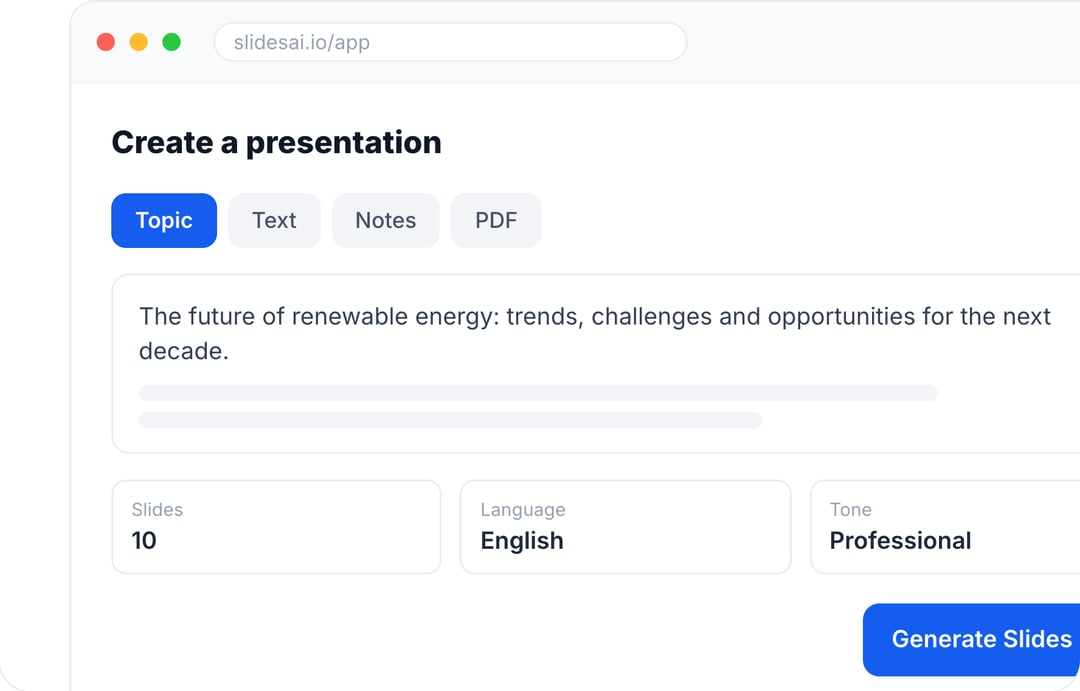
You can use SlidesAI through its web app, Google Slides extension, or PowerPoint integration.
Choose whichever setup fits the way you normally create presentations.
Step 2: Give SlidesAI Your Starting Material
SlidesAI gives you two straightforward ways to create a presentation.
Option 1: Enter Only a Topic
If you are starting from scratch, enter your topic and let SlidesAI build the initial presentation around it.
Option 2: Upload Existing Material
Already have a business plan, notes, research, or other material? You can use that content as the starting point instead of writing everything again.
This can be useful when you already have the information but need help turning it into a presentation.
Step 3: Configure Your Presentation Preferences
Next, set the preferences for your presentation.
For a pitch deck, choose:
- Presentation Type: Business Pitch
- Audience: The investors, customers, partners, or stakeholders you are presenting to
- Tone: Choose a tone that fits your business and audience
- Language: English
These settings give SlidesAI more context about the type of presentation you are trying to create.
Step 4: Add Additional Context
This is worth spending a little time on.
Tell SlidesAI anything else it should know about the presentation. You can mention whether you will be presenting the deck live or sending it to someone to read on their own.
You can also specify how long the presentation should be and add instructions about what you want the deck to focus on.
The more useful context you provide here, the easier it is to get an outline that actually fits your situation instead of a generic business presentation.
Step 5: Pick a Pitch Deck Template
Now choose a design for your presentation.
For an investor or business pitch, it is usually better to keep things clean and easy to read. You want the audience looking at your business rather than trying to figure out what is happening on the slide.
You can also upload your logo and adjust the visuals to match your brand.
Step 6: Review the AI-Generated Outline
Before the full presentation is created, SlidesAI will generate an outline.
Take a moment to read through it.
Does the order make sense? Is the problem introduced early enough? Is there enough space for your traction and financials? Does the story build naturally toward your ask?
If something feels out of place, change it before moving forward.
Step 7: Edit and Finalize the Presentation
Once the pitch deck is generated, go through every slide.
AI can give you a strong starting point, but you should still add your own numbers, examples, screenshots, customer information, and business details.
Cut anything that does not add value. Fix claims that need more context. Make sure the financial figures are accurate.
The final deck should sound like your business, not like a presentation generated by a tool.
Create Presentations in Minutes With SlidesAI
- Start with a topic, text, notes, or PDF
- Generate slides in minutes
- Customize your presentation with ease
What Makes a Great Pitch Deck?
A good pitch deck does not need to be complicated. In fact, adding more information can sometimes make it harder for people to understand the actual idea.
Here are a few things worth keeping in mind.
- Keep It Brief
People do not want to read your entire business plan inside a presentation. Keep the slides focused on the information your audience actually needs.
If a point can be explained in one sentence, do not use a paragraph.
- Tell a Story
Your slides should feel connected.
Start with the problem. Introduce the solution. Show the market. Explain how you will reach customers. Then bring in the team, financials, and the ask.
Someone should be able to understand why each slide comes after the previous one.
- Define the Problem Simply
Do not make your audience work to understand what you are solving.
A clear problem statement can often do more for your pitch than a slide full of complicated industry terminology.
- Show Real Traction
If people are already using your product, buying from you, signing up, or showing interest, put that information in the deck. Even early signs can help, including having done a domain name search and secured your web address, set up a landing page, or launched a waitlist. Revenue, customer growth, retention, partnerships, waitlists, or successful pilots can all tell a more convincing story than vague claims about future growth.
5 Make a Clear Ask
Do not finish with a vague statement about “looking for opportunities.”
Tell the audience exactly what you need and what you plan to do with it.
- Use Clean Design
A pitch deck should be easy to scan.
Use readable fonts, enough white space, simple charts, and visuals that actually support the information. You do not need a different design trick on every slide.
Best Pitch Deck Examples That Got Funded
Some of the most well-known startup pitch decks are still studied by founders today. They are useful examples, but there is an important catch: you should study the thinking behind these decks rather than blindly copy their slides.
What worked for a company raising money in 2009 may not work in the same way today.
- Airbnb
Airbnb’s early pitch deck is probably one of the best examples of keeping things simple. The deck clearly explained the problem with expensive hotel stays, showed how Airbnb offered a different option, and then backed the idea with market data. It raised $600,000 in seed funding in 2009.
- Shopify
Shopify is a good example of how you can pitch a business by focusing on a specific problem rather than trying to appeal to everyone at once. The company started with a fairly focused idea around making online selling easier. Its early funding story shows why it helps to explain exactly who you are building for, what problem you are solving, and why that audience needs your product.
- Tinder
Tinder’s original deck, created when the app was still called Matchbox, took a more product-focused approach. Instead of filling the presentation with complicated explanations, it showed how the app worked and connected the product to a problem people could easily relate to. That makes it a useful example for consumer apps and other products where showing the experience can be more convincing than simply describing it.
- Uber
Uber’s early pitch deck is useful if you are building something that changes how an existing service works. The original UberCab deck presented a familiar problem with taxis and then showed a much simpler way for customers to request a ride. It did not need to explain the entire future of the company. It just had to make investors understand why the idea could work.
- WeWork
WeWork’s Series D deck took a very different approach. It focused heavily on growth, market opportunity, the company’s expanding footprint, and its larger vision for the workspace market. It is a useful example if you are pitching an established business with traction, although its long format is not something you necessarily need to copy for an early-stage pitch.
Closing Thoughts
Creating a pitch deck is less about making a presentation look impressive and more about making your business easy to understand. Start with the problem, explain your solution, show why there is an opportunity, and give your audience a reason to believe you can make it work. Once the story is clear, tools like SlidesAI can help you turn that information into a presentation without having to build every slide from scratch.
FAQs
Is a pitch deck the same as a business plan?
No. A pitch deck is a short visual presentation designed to communicate an idea quickly. A business plan is much more detailed and usually covers areas such as operations, financial planning, market research, and long-term strategy.
Can I use a template to create a pitch deck?
Yes. A template can give you a starting point for the structure and design. Just make sure you change the content and layout to fit your business instead of filling in a template without thinking about the story.
What should you not include in a pitch deck?
Avoid unnecessary text, unrealistic financial projections, unsupported claims, overly complicated charts, and information that does not help explain your business. If a slide does not add anything to the story, consider removing it.
Are pitch decks only for investors?
No. Pitch decks can also be used for sales presentations, partnerships, product launches, marketing proposals, internal projects, and other business discussions.
How long should a pitch deck be?
There is no universal number, but shorter is usually better when you are pitching. A focused deck of around 10 to 15 slides can be enough for many early-stage pitches. The exact length depends on your audience, business stage, and purpose.
Can I create a pitch deck in Google Slides?
Yes. Google Slides is commonly used for creating and sharing presentations. You can also use tools such as SlidesAI through its Google Slides integration to help generate and structure presentation content.
What is the ideal font size for a pitch deck?
There is no single perfect size, but your text should be large enough to read without effort. As a general starting point, around 24 to 32 points works well for body text, while slide headings can be considerably larger. Always check how the presentation looks when viewed at normal size rather than relying only on your editing screen.