

You’ve got 60 seconds to think and 2 minutes to speak. Your name is called, the room is quiet, and you need to say something clear, confident, and relevant right now. That moment defines impromptu presentations.
Impromptu presentations are short, unplanned talks where structure matters more than polish, and clarity matters more than content volume.
This guide gives you exactly what you need under pressure: ready-to-use impromptu presentation topics, simple frameworks, time-based topic lists, practice drills, and a fast workflow to turn a quick outline into clean slides using AI tools like SlidesAI.
Key Takeaways
- When time is limited for an impromptu presentation, a simple framework matters more than perfect wording, as clear structure helps you stay focused and confident.
- Strong impromptu talks center on one clear message supported by two or three key points, since covering too much often leads to rambling and confusion.
- Frameworks like PREP, STAR, and the Three T’s provide an instant mental roadmap, making it easier to organize your thoughts on the spot.
- Relatable, experience-based topics allow you to speak more naturally and adapt quickly, even with minimal preparation time.
- Clean, minimal slides created quickly with tools like SlidesAI reinforce your message without distracting from your delivery.
What Is an Impromptu Presentation?
An impromptu presentation is a brief, unprepared talk delivered with little to no prep time, usually lasting between one and three minutes. You encounter it in classrooms, meetings, interviews, stand-ups, and even social settings like toasts.The goal is simple: communicate one clear idea with two or three supporting points.
This type of presentation involves thinking quickly, organizing ideas on the spot, and communicating clearly. Most impromptu talks allow 30–60 seconds of preparation and 1–3 minutes of speaking time. Some professional or academic settings extend this to five minutes when examples or reasoning are required.
125+ Topics for Impromptu Presentations
Choosing the right topic is half the battle. These impromptu presentation topics are organized by audience and context for fast selection.
Impromptu Topics for Students
These impromptu presentation topics are designed for students at different education levels and are divided accordingly for easy selection. They focus on relatable experiences, simple opinions, and everyday challenges so students can speak confidently with minimal preparation.
Topics for Middle School Student
- Why kindness matters in school
- Should homework be reduced?
- How technology affects friendships
- My dream invention
- What makes a good class leader
- Why reading stories is still important
- The importance of helping others
- Should schools have longer breaks?
- What makes someone a role model?
- How to deal with peer pressure
- Why art and music classes matter
- Should mobile phones be allowed in school?
- The importance of teamwork in group projects
- Why physical activity is important
- Should students wear uniforms?
- What makes a teacher great?
- Why learning new hobbies is fun
- How to make school mornings easier
- Should school lunch be healthier?
- Why everyone should learn public speaking early
Topics for High School Student
- The impact of social media on self-esteem
- Should school uniforms be mandatory?
- How teenagers can manage stress
- Why financial literacy should be taught
- Is AI helping or ruining learning?
- The role of youth in activism
- Balancing studies with hobbies
- Should schools have mental health days?
- Do part-time jobs build responsibility?
- Are standardized tests outdated?
- Should smartphones be banned in classrooms?
- Is traditional grading fair?
- How to prepare for life after high school
- Should schools teach real-life skills?
- Should students vote on school policies?
- Does social media affect academics?
- Should school sports be free?
- Are digital-only exams effective?
- Should attendance be mandatory?
- Is class rank still relevant?
“Need a clean deck fast? Explore our presentation templates and turn last-minute topics into polished slides in minutes.”
Topics for College Students
- How internships shape careers
- Should college education be free?
- The ethics of AI in academics
- The importance of networking
- Mental health challenges in college
- Are traditional exams outdated?
- Online degrees vs traditional degrees
- Should lecture attendance be mandatory?
- Soft skills vs technical skills
- How technology is changing learning
- Student debt and life decisions
- Is remote learning the future?
- Should community service be required?
- Campus culture and identity
- Flexible schedules in higher education
- Are college clubs essential?
- Should tuition fees be transparent?
- How international students add value
- Single-use plastics on campus
- Is college worth the cost?
Read in detail – Top Presentation Topics for Students
Professional and Business Topics
These topics are tailored for workplace settings such as meetings, interviews, and leadership discussions. They emphasize real-world scenarios, clear thinking, and practical insights that professionals can communicate quickly and effectively.
- Communicating under pressure
- Emotional intelligence in leadership
- The power of storytelling in business
- Managing workplace conflict
- Productivity habits that work
- The future of remote work
- Building client trust quickly
- Overcoming imposter syndrome
- Giving constructive feedback
- Managing burnout
- Running effective meetings
- Why organizations resist change
- Negotiation skills for professionals
- Handling difficult clients
- Data-driven decision-making
- Personal branding at work
- Encouraging creativity in teams
- Inclusive leadership
- Automation and job roles
- Continuous learning
- Balancing innovation and stability
- AI and productivity
- Networking internally
- Why soft skills matter
- Lessons from professional setbacks
Read in detail – Top Human Resource Presentation Topics for Modern Workplaces
Funny or Light Impromptu Presentation Topics
Light-hearted, impromptu presentation topics help break the ice and reduce speaking anxiety. These prompts are ideal for warm-ups, workshops, or informal settings where the goal is engagement, humor, and quick thinking rather than deep analysis.
- Why naps should be considered a life skill
- My secret talent nobody asked for
- Why pets would be better leaders
- The mystery of disappearing socks
- The art of doing nothing
- How to survive a group project
- Why Mondays need a rebrand
- The world’s most useless inventions
- Why embarrassing moments make great stories
- Life as a coffee addict
- Why WiFi is the real oxygen
- How to look productive without working
- The tragedy of auto-correct
- Why does everyone have a “favorite” pen
- The power of the snooze button
- Why “reply all” is dangerous
- How pets secretly judge us
- The emotional chaos of online shopping
- Why printers always break at the wrong time
- The mystery drawer every house has
- The science of binge-watching
- If food could talk
- Why every meeting needs dessert
- Mastering the awkward wave
- Why procrastination is an art
Read in detail – 400+ Funny PowerPoint Night Ideas to Steal The Show
Persuasive or Debate-Oriented Prompts
Persuasive ideas for impromptu presentations challenge you to form and defend an opinion. These topics are well-suited for debates, classroom discussions, panels, and interview-style scenarios where logical structure matters more than perfect delivery. They help you practice reasoning and persuasion.
- Why naps should be considered a life skill
- My secret talent nobody asked for
- Why pets would be better leaders
- The mystery of disappearing socks
- The art of doing nothing
- How to survive a group project
- Why Mondays need a rebrand
- The world’s most useless inventions
- Why embarrassing moments make great stories
- Life as a coffee addict
- Why WiFi is the real oxygen
- How to look productive without working
- The tragedy of auto-correct
- Why does everyone have a “favorite” pen
- The power of the snooze button
- Why “reply all” is dangerous
- How pets secretly judge us
- The emotional chaos of online shopping
- Why printers always break at the wrong time
- The mystery drawer every house has
- The science of binge-watching
- If food could talk
- Why every meeting needs dessert
- Mastering the awkward wave
- Why procrastination is an art
Got your topic? Now use the AI PowerPoint generator to turn it into clean, ready-to-present slides in seconds.
Simple Frameworks for Impromptu Presentations
When time is limited, structure keeps you from rambling. These frameworks help you organize your thoughts quickly and speak with confidence.
- The Three T’s Framework -Tell them what you’ll talk about, talk about it, then tell them what you talked about. This works well for general explanations.
- PREP (Point, Reason, Example, Point) – Ideal for persuasive or opinion-based topics. State your point, support it with a reason, give a quick example, and restate the point.
- STAR (Situation, Task, Action, Result) – Best for interviews and workplace examples. It keeps stories concise and focused.
- Pros–Cons–Recommendation – Useful for decision-making topics. Outline benefits, drawbacks, and end with a recommendation.
- What? So What? Now What? – Describe what happened, explain why it matters, and state what should happen next.
Quick Comparison of Frameworks
| Structure | Best For | Steps | Ideal Time |
|---|---|---|---|
| Three T’s | General clarity | Intro → Body → Recap | 1–3 min |
| PREP | Persuasion | Point → Reason → Example → Point | 1–3 min |
| STAR | Work examples | Situation → Task → Action → Result | 1–5 min |
| Pros–Cons–Rec | Decisions | Pros → Cons → Recommendation | 1–3 min |
| What? So What? Now What? | Updates & reflections | Describe → Meaning → Action | 1–3 min |
Quick Workflow: From Topic to Talk (and Slides) in 5 Steps
When time is limited, success depends on making fast, focused decisions. This five-step workflow helps you move from a blank mind to a clear, confident impromptu presentation.
- Pick a Focused Prompt Fast
Choose a narrow, familiar topic instead of something broad or abstract. Using a generator or a curated list of topics for impromptu presentations helps you decide quickly. So, you can spend your limited time organizing ideas, not debating options.
- Choose a Simple Structure
Select one proven framework like Three T’s, PREP, or STAR and stick to it. A clear structure prevents rambling and gives your talk a logical flow, even if your wording is spontaneous.
- Open Strong, Close Clearly
Start with a clear point, question, or statement to anchor your talk immediately. End by restating your main message and what it means for the audience so your presentation feels complete, not cut off.
- Manage Nerves and Pace
Pause before you speak, breathe steadily, and slow your delivery slightly. Speaking calmly and deliberately helps your audience follow your message and gives you time to think as you talk.
- Build Minimal Slides Quickly
If slides are required, keep them simple. One headline, one to three supporting bullets, and a relevant image are enough. Minimal slides support your message without distracting from your delivery.
Common Pitfalls While Presenting Impromptu Topics and Fast Fixes
Even confident speakers struggle with impromptu presentations. The key is recognizing common mistakes early and applying fast fixes that bring your talk back on track.
- Rambling: Focus on a Single Message With Two or Three Supporters
Speakers who pursue several ideas at once are said to be rambling. To solve this, pick a single, concise message and provide just two or three examples or arguments to support it.
- Freezing: Take a Deep Breath, Stop, and Apply a Basic Framework
Instead of hurrying, stop and take a breath if your thoughts are blank. Reverting to a well-known framework provides you with a mental road map and facilitates a smooth resumption of your flow.
- Over-Scoping: Limiting the Subject to Make Time
Attempting to cover too much results in hurried delivery, and ambiguous points is a big mistake. Focus on just one aspect of your subject that satisfies both the audience’s expectations and the time constraint.
- Weak Conclusions: Reiterate the Lesson and Take Action
Many spontaneous conversations come to a sudden and unresolved finish. To help the audience remember your message, restate your primary point and include a little takeaway or action.
Learn more about “Common Presentations Mistakes to Avoid“
How SlidesAI Supports Last-Minute Decks?
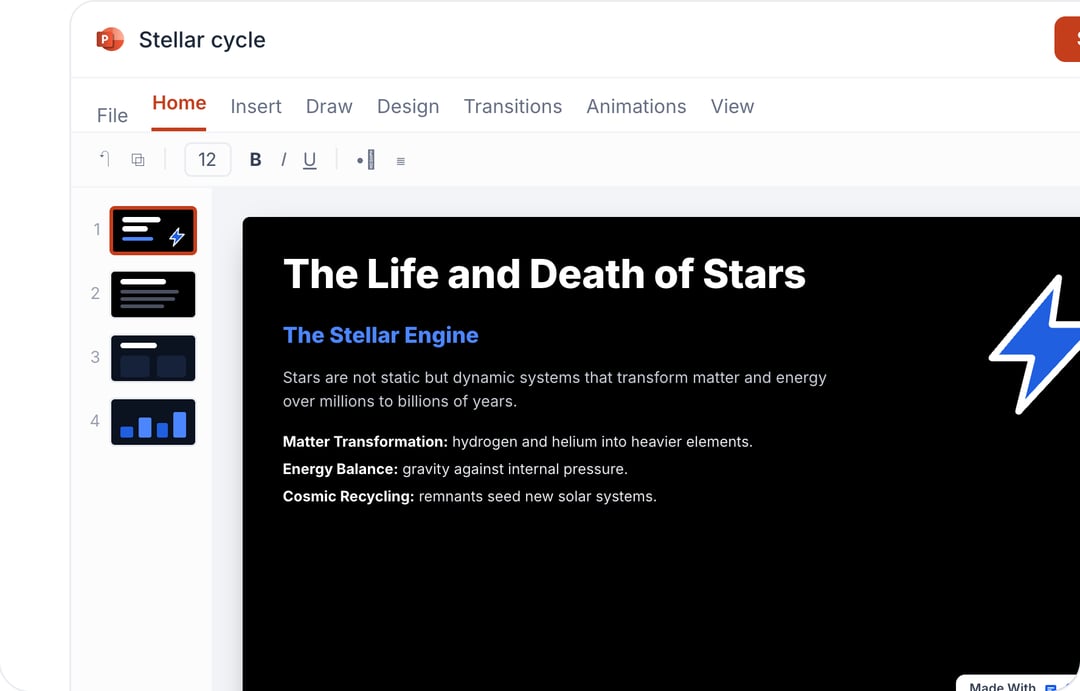
Once you’ve selected an impromptu presentation topic, designing slides shouldn’t slow you down. With SlidesAI, you can paste your topic or outline and instantly generate clear, organized slides in seconds.
SlidesAI works especially well for impromptu talks, where slides need to be simple, focused, and distraction-free. It’s useful for students, professionals, and speakers who need clear visuals fast, without dealing with complex design tools. With easy customization options and ready-made layouts, it’s one of the fastest ways to turn a last-minute idea into a polished presentation that supports your message instead of slowing you down.
Take Your PowerPoint From Basic to Professional With SlidesAI
- Improve your slide content with AI
- Create polished layouts faster
- Work directly inside PowerPoint

Final Words
Just remember, impromptu presentations don’t reward perfection. They reward clarity, focus, and calm thinking. With a simple framework, familiar topics, and a few practice drills, you can speak confidently even when called on without warning.
The process is simple! Pick a relevant topic for your impromptu presentation, choose a structure, rehearse briefly, and let AI handle the slides.
Finding the right presentation topic doesn’t have to be overwhelming. We’ve put together a collection of blogs to help you find ideas for every occasion, audience, and time limit. Browse through our guides below and take the guesswork out of choosing what to present.
- 250+ Best Presentation Topics from Different Categories & Useful Tips
- Best 5-Minute Presentation Ideas: Topics, Tips & How to Pick One
- Best Science Topics for Students and Professionals
- Best Leadership Topics for Presentation
- Top 10 Pecha Kucha Ideas for Presentation
- 10 Minute Presentation Ideas: Best Topics, Examples & Tips
FAQs
1. What is an example of an impromptu presentation?
An impromptu presentation is a short, unplanned talk, such as being asked to explain your opinion on a topic during a meeting or class without prior preparation.
2. What are the best impromptu presentation topics for college students?
Topics tied to student life work best, like social media habits, exam stress, part-time jobs, or whether online learning is effective.
3. What’s an easy impromptu topic for business meetings?
Simple, experience-based topics like “one process improvement,” “a recent customer insight,” or “a lesson from a recent project” are easy and effective.
4. How can I practice impromptu speaking at home?
Pick a random topic, set a one-minute timer, and speak using a basic structure like intro, one point, and takeaway. Recording yourself helps improve clarity and pacing.
5. What are funny topic ideas for an impromptu presentation that still teach a lesson?
Light topics like “what coffee habits say about productivity” or “lessons learned from bad meetings” keep things fun while delivering a clear takeaway.
6. How can I use AI to create slides for an impromptu talk?
AI tools like SlidesAI can turn your topic or short notes into clean slides instantly. Thus, it helps you focus on delivery instead of design.
7. What topics work best for interviews or panel Q&A?
Topics based on problem-solving, leadership experiences, failures, or lessons learned work well because they show thinking, not memorization.
8. What are engaging topics for an impromptu presentation for a team standup?
Quick updates like “one win, one challenge,” “a small improvement idea,” or “what I learned this week” keep standups focused and engaging.
9. Should I use a story or data in an impromptu talk?
A short personal story usually works better than data under pressure, but one simple stat can help if it’s easy to remember and relevant.
10. What impromptu structures actually work under pressure?
Simple frameworks like PREP (Point, Reason, Example, Point) or the Three T’s (Tell them what, why, and takeaway) work best when time is limited.