Creating a persuasive presentation can be challenging. Research shows that most audiences prefer talks lasting not more than 10-15 minutes, and 35% of millennials engage only with a compelling story. Therefore, choosing the right persuasive presentation topics is the first step towards truly connecting with your audience.
This guide shows you how to choose good persuasive presentation topics, structure your talk effectively, and deliver it with impact. It also demonstrates how AI tools like SlidesAI can streamline the process and turn your ideas into engaging, polished decks in minutes from just Presentation Topics.
What is a Persuasive Presentation?
A persuasive presentation aims to change audience beliefs, attitudes, or behaviors by convincing them to accept your viewpoint or take a specific action. Unlike informative talks that focus on facts, persuasive presentations are action-oriented, often following a problem–solution format and including a clear call to action (CTA).
Persuasive presentations use storytelling, evidence, and emotional appeal to motivate action.
These are some of the classical appeals or thumb rules of a typical persuasive presentation:
- Ethos (Credibility): Establish trust and authority on your topic.
- Pathos (Emotion): Connect with your audience’s feelings to strengthen persuasion.
- Logos (Logic): Use data, reasoning, and evidence to support claims.
- Kairos (Timing): Tailor your message to the context and urgency of the topic.
Persuasive vs. Informative Presentations
Why can’t you just present an informative presentation? Why is there so much fuss about giving a persuasive presentation only? Well, Informative presentations merely educate while persuasive presentations convince. In short, informative focus on what and how, while persuasive emphasizes why, often with emotional hooks and call to action.
Understanding the difference between these types of presentations is crucial for picking the right topic and approach.
| Aspect | Persuasive Presentation | Informative Presentation |
|---|---|---|
| Primary Goal | Convince the audience to adopt a view or act | Explain or educate objectively |
| Structure | Hook → Problem → Solution → Benefits → CTA | Hook → Define → Explain → Summarize |
| Emotional Appeals | High (pathos + ethos) | Low to moderate |
| Visuals | Contrast “status quo vs solution,” proof, CTA | Diagrams, facts, process |
How to Choose the Right Topics for Persuasive Presentations?
Picking the right topic is half the battle. A great topic aligns your passion, audience interest, and credibility while remaining arguable and timely.
- Find the Overlap: Your Passion × Audience Interest: Choose a topic you care about. It energizes your delivery. Then pair it with what your audience finds relevant for maximum engagement.
- Ensure Pathbreaking and Avoid Clichés: Choose topics that invite debate. Avoid overused ideas that fail to spark interest.
- Prioritize Freshness and Timeliness: Current issues resonate more. Highlight recent trends, events, or policies to stay relevant.
- Check Your Ethos (Credibility): Can you speak authoritatively on the subject? Expertise strengthens persuasion.
- Stress-Test Counterarguments Before You Commit: Anticipate opposing views to build a robust, persuasive argument.
Persuasive Presentation Topic Ideas by Category
Here’s a curated list of good persuasive presentation topics across 12 categories, perfect for students, teachers, and early professionals.
Technology and Privacy
Technology touches every part of our lives, but it also raises concerns around privacy, security, and ethics. These topics help you persuade your audience about the importance of safeguarding data and responsible tech use.
- Why Governments Should Regulate Facial Recognition Technology: Explore the risks of surveillance and the need for legal oversight to protect citizens’ privacy.
- The Case For Banning Data Brokers: Argue why companies that trade personal data threaten individual privacy and should be restricted.
- Why Apps Must Adopt End-To-End Encryption by Default: Persuade your audience that strong encryption safeguards user communication and trust.
- The Need for Stronger Student Data Protection Laws: Highlight the importance of securing sensitive student information from misuse.
- Should AI Be Allowed to Access Personal Health Records: Discuss the balance between AI innovation and patient privacy.
- Why Smart Home Devices Should Have Mandatory Privacy Labels: Advocate for transparency about how devices collect and use personal data.
- The Ethical Concerns of Biometric Authentication: Examine the moral and privacy implications of using biometric data like fingerprints or facial scans.
- Why Companies Should Be Penalized for Major Data Breaches: Emphasize accountability and the need for strict consequences.
- Should Schools Restrict Digital Tracking of Students: Argue for limits on monitoring student behavior online to protect their privacy.
- The Privacy Risks Behind Location-Based Advertising: Persuade that tracking user locations for ads raises significant privacy concerns.
- Why Children Need Stricter Online Privacy Protections: Highlight the vulnerability of minors to data exploitation.
- Should Police Require Warrants to Access Digital Data: Discuss legal safeguards needed for citizen privacy in the digital age.
- Why Social Platforms Must Simplify Privacy Settings: Argue that clear and simple settings empower users to protect their information.
- The Dangers of Unlimited Corporate Data Collection: Persuade audiences that unchecked data collection is risky and invasive.
- Should Tech Companies Face Criminal Liability for Privacy Violations: Advocate for serious consequences for breaches of user trust.
- Why “Opt-in Consent” Should Be the Industry Standard: Emphasize informed consent as the ethical baseline for data collection.
- Should AI Models Be Restricted From Training on Personal Data?: Explore the ethical use of personal information in AI development.
- Why Employees Deserve Transparency About Workplace Surveillance: Argue that companies must disclose monitoring practices to staff.
- The Need For Global Data Privacy Standards: Persuade that consistent international rules protect users across borders.
- Why Teens Should Be Educated on Digital Footprints: Highlight the importance of teaching responsible online behavior early.
Environment and Sustainability
Environmental issues impact everyone. Sustainability is key to preserving the planet for future generations. These topics aim to persuade your audience to take action for a greener and healthier world.
- Why Plastic Bags Should Be Completely Banned: Argue that eliminating plastic bags reduces pollution and protects wildlife.
- The Case for Mandatory Recycling Programs in Every City: Persuade that systematic recycling improves resource efficiency and environmental health.
- Why Renewable Energy Should Replace Fossil Fuels Faster: Highlight the urgency of switching to cleaner energy sources.
- Should Governments Subsidize Electric Vehicles More Aggressively: Advocate for incentives to accelerate EV adoption and reduce emissions.
- The Need for Stricter Laws on Industrial Pollution: Argue for regulations to prevent environmental degradation from factories.
- Why Fast Fashion is Harming the Planet: Persuade that overproduction and waste in fashion damage ecosystems.
- Should Water-Intensive Crops Be Restricted During Droughts: Highlight the importance of sustainable agricultural practices.
- The Argument for Composting Mandates in Households: Persuade that composting reduces landfill waste and enriches soil.
- Why Cities Should Invest in Green Public Transportation: Advocate for sustainable urban transport to lower emissions.
- Should Meat Consumption Be Reduced Through Policy: Explore the health and environmental benefits of plant-based alternatives.
- Why Corporations Must Publish Sustainability Reports: Persuade that transparency drives accountability and eco-friendly practices.
- The Need for Nationwide Reforestation Programs: Advocate for large-scale tree planting to restore ecosystems.
- Should Single-Use Plastic Packaging Be Illegal?: Highlight the waste and pollution caused by disposable plastics.
- Why Climate Change Education Must Be Part of School Curricula: Persuade that awareness leads to action.
- Should Countries Impose Carbon Taxes on Airlines?: Argue that financial incentives can reduce carbon emissions in aviation.
- Why Sustainable Farming Deserves Greater Funding: Highlight the long-term benefits of eco-friendly agriculture.
- Should Governments Ban Gas-Powered Cars by a Specific Year: Persuade audiences to embrace electric mobility.
- Why Businesses Must Adopt Circular Economy Practices: Advocate for reuse and recycling to minimize waste.
- Should Households Get Tax Rebates for Solar Installation: Highlight incentives to encourage clean energy adoption.
- The Need for Protecting Endangered Ecosystems and Wildlife: Persuade that conservation is critical for biodiversity.
Education and School Policy
Education shapes the future, and school policies can profoundly affect learning outcomes. These persuasive topics for presentation persuade audiences about innovative, practical changes that improve student success.
- Why Financial Literacy Should Be Mandatory in Schools: Argue that understanding money prepares students for real-world challenges.
- The Case for Banning Homework in Elementary Grades: A Persuasive argument that reducing homework improves childhood well-being and focus.
- Should Schools Adopt AI Tools Like Slidesai for Learning: Advocate for AI-enhanced education to boost engagement and efficiency.
- Why Standardized Tests Should Be Replaced With Skill-Based Assessments: Highlight the value of measuring practical abilities over rote learning.
- Should Schools Extend Mental Health Support Programs: Persuade that student well-being must be prioritized for academic success.
- Why Smartphones Should Be Limited During Class Hours: Argue that reduced distractions improve focus and learning outcomes.
- Should Schools Switch to Year-Round Learning?: Explore the benefits of continuous education over traditional schedules.
- The Need for Better Nutrition Standards in School Cafeterias: Persuade that healthy meals support student performance.
- Should College Education Be Free: Advocate for accessibility and equity in higher education.
- Why Arts Education is Essential, Not Optional: Highlight how creative skills enhance learning and problem-solving.
- Should Schools Integrate Coding Into Core Subjects: Persuade that programming prepares students for the digital age.
- The Case for Expanding Career Counseling Services: Argue that guidance helps students make informed future choices.
- Should Uniforms Be Mandatory in High Schools: Explore benefits for equality and school culture.
- Why Sex Education Must Be Comprehensive: Persuade that informed students make safer and healthier choices.
- Should Schools Require Volunteer Service for Graduation: Advocate for civic engagement and social responsibility.
- Why Hybrid Learning Should Remain After the Pandemic: Highlight flexibility and personalized learning benefits.
- Should Schools Track Attendance With Digital Tools: Persuade that data-driven monitoring improves accountability.
- The Need for Integrating Entrepreneurship in the Curriculum: Argue that fostering innovation prepares students for the workforce.
- Should School Start Times Be Pushed Later? Highlight health and focus benefits from later start times.
- Why PE Classes Should Promote Lifelong Fitness Habits: Persuade that early exercise builds lifelong wellness habits.
Read in detail – Top Presentation Topics for Students
Physical and Mental Health
Health and mental well-being are crucial for a productive, balanced life. These topics persuade audiences about policies, habits, and interventions that promote physical and emotional wellness.
- Why Mental Health Screening Should Be Mandatory in Schools: Advocate for early detection and support for students’ mental health.
- Should Therapy Be Covered 100% By Insurance: Persuade that access to mental health care is a right, not a luxury.
- The Case For Banning Ultra-Processed Foods: Highlight the health risks and long-term consequences of processed diets.
- Why Social Media Detoxes Improve Mental Health: Argue that digital breaks reduce stress and anxiety.
- Should Workplaces Offer Mandatory Mental Health Days: Persuade that employee well-being improves productivity.
- The Need For Better Public Funding for Addiction Treatment: Advocate for accessible rehabilitation programs.
- Should Sugary Drinks Be Taxed Like Tobacco: Highlight public health benefits of discouraging excessive sugar intake.
- Why Mindfulness Should Be Taught To Children: Persuade that mindfulness builds resilience and focus early in life.
- Should Physical Activity Be Mandatory at Workplaces?: Argue that regular movement promotes employee health.
- The Case for Stricter Regulations on Unhealthy Food Advertising: Highlight the role of marketing in dietary choices.
- Should Governments Invest More in Vaccine Research? Advocate for proactive public health initiatives.
- Why Sleep Should Be Prioritized as a National Health Issue: Persuade that adequate rest is essential for well-being.
- Should Mental Health Apps Be Regulated More Strictly?: Argue that oversight ensures effectiveness and safety.
- Why Fast Food Chains Must Display Clearer Nutritional Labels: Highlight the importance of informed food choices.
- Should Antidepressants Be Prescribed More Cautiously: Persuade for careful, personalized medical treatment.
- The Argument for Universal Healthcare: Advocate for equitable access to medical services for all.
- Why Workplaces Should Adopt Burnout-Prevention Policies: Highlight strategies to maintain employee mental health.
- Should Influencers Be Restricted From Promoting Unhealthy Products?: Argue for responsible marketing and consumer safety.
- Why Emotional Intelligence Training Should Be Normalized: Persuade that EI improves personal and professional relationships.
- Should Processed Sugar Be Treated as an Addictive Substance? Highlight the public health implications of excessive sugar consumption.
Found a persuasive presentation topic you like? Use an AI Google Slides generator to turn your idea into a polished presentation in minutes.
Government, Law, and Policy
Government decisions shape societies. Therefore, topics for a persuasive presentation in this sphere explore policies, reforms, and ethical considerations that improve governance and civic life.
- Should Voting Be Mandatory: Argue that compulsory voting increases democratic participation.
- The Case For Lowering the Voting Age to 16: Persuade that youth engagement strengthens democracy.
- Why Prisons Should Prioritize Rehabilitation Over Punishment: Advocate for reform-focused criminal justice.
- Should Political Ads Be Banned on Social Media?: Highlight the risks of misinformation and manipulation.
- The Need for Stronger Anti-Corruption Laws: Persuade that transparency strengthens governance.
- Should the Government Regulate AI-Generated Content: Argue for oversight to prevent harm and misinformation.
- Why Campaign Finance Reform is Overdue: Advocate for fair and transparent election funding.
- Should Governments Subsidize Childcare: Highlight social and economic benefits for families.
- The Argument for Universal Basic Income: Persuade that UBI can reduce poverty and inequality.
- Should the Legal Drinking Age Be Lowered: Explore the pros and cons of age-based restrictions.
- Why Whistleblowers Need Stronger Protection: Advocate for safeguarding those exposing wrongdoing.
- Should the Death Penalty Be Abolished Worldwide: Argue for humane justice and abolition of capital punishment.
- Why Governments Must Enforce Anti-Discrimination Laws More Strictly: Persuade that equality requires robust enforcement.
- Should Lobbying Be Restricted or Banned: Highlight the influence of money in politics and the need for reform.
- The Need for Expanded Privacy Rights: Advocate for personal data protection in the digital era.
- Should Public Transport Be Free for All: Persuade that accessible transit benefits society and the environment.
- Why Immigration Laws Should Be Reformed: Argue for fairer and more practical immigration policies.
- Should Civic Education Be Mandatory for Adults: Highlight the importance of informed citizenship.
- The Case for Limiting Executive Powers: Persuade that checks and balances protect democracy.
- Should There Be Stricter Gun Control Regulations: Advocate for safety and responsible firearm policies.
Social Media and Society
Social media shapes opinions, behavior, and culture. Thus, social-media-related persuasive topics for presentation persuade audiences about responsible usage, regulation, and societal impact.
- Why Social Media Should Require Identity Verification: Argue that verification reduces fake accounts and online harm.
- Should Influencer Marketing Be Regulated Like Advertising: Persuade that accountability improves consumer trust.
- Why Social Platforms Must Address Misinformation Faster: Highlight the dangers of false content on public opinion.
- Should Children Under 13 Be Banned From Social Media Entirely: Advocate for protecting young users from online risks.
- The Argument for Limiting Screen Time for Teens: Persuade that moderation supports mental and physical health.
- Why Social Media Fuels Unrealistic Beauty Standards: Highlight harmful societal pressures caused by curated content.
- Should Platforms Hide Follower Counts: Argue that removing metrics can reduce social pressure and comparison.
- Why Digital Detoxes Should Be Normalized: Persuade that breaks improve mental clarity and well-being.
- Should Companies Be Responsible for User Harm Caused by Their Platforms: Advocate for corporate accountability.
- The Impact of Algorithms on Political Polarization: Highlight how content recommendations influence beliefs.
- Should Content Creators Be Taxed Differently: Persuade for fair regulation of digital earnings.
- Why Social Media Addiction Should Be Treated as a Public Health Issue: Advocate for recognizing and addressing compulsive usage.
- Should AI-Generated Influencers Be Banned: Argue that artificial personas affect trust and authenticity online.
- Why Anonymous Hate Speech Must Be Criminalized: Persuade that anonymity cannot shield harmful behavior.
- Should Employers Check Applicants’ Social Media: Highlight ethical and privacy concerns in hiring.
- The Case for Banning Deepfakes: Advocate for regulations to prevent misinformation and fraud.
- Why Social Media Companies Must Be Transparent About Algorithms: Persuade that transparency builds trust.
- Should Public Figures Be Held to Stricter Online Conduct: Argue that role models influence societal behavior.
- Why Social Media Should Promote Educational Content: Advocate for constructive use of platforms.
- Should Platforms Limit “Doomscrolling” With Built-In Restrictions: Persuade that design can improve mental health.
Business and Economy
Persuasive business and economy presentation topics focus on policies, practices, and trends that shape commerce, employment, and economic growth.
- Why Remote Work Should Remain a Long-Term Option: Persuade that flexibility benefits productivity and work-life balance.
- Should Companies Adopt Four-Day Workweeks?: Argue that shorter weeks can boost efficiency and employee satisfaction.
- Why Small Businesses Need Greater Tax Incentives: Advocate for support that fosters growth and innovation.
- Should Internships Always Be Paid: Highlight fairness and accessibility for career starters.
- The Need For Stronger Consumer Protection Laws: Persuade that safeguards ensure trust and market fairness.
- Should Companies Disclose Salary Ranges in Job Postings: Argue for transparency to reduce pay gaps.
- Why Sustainable Business Practices are Profitable: Advocate that eco-friendly operations improve reputation and revenue.
- Should Governments Regulate Monopolies More Strictly: Persuade that competition ensures fair markets.
- Why Startups Should Invest in AI Tools Early: Highlight efficiency and growth benefits of technology adoption.
- Should Gig Workers Receive Employee Benefits: Argue for fairness and social security for flexible workers.
- The Case for Workplace Diversity Initiatives: Persuade that inclusivity drives innovation and productivity.
- Should Companies Limit Workplace Surveillance: Advocate for employee privacy and trust.
- Why Customer Data Transparency Builds Trust: Highlight ethical use of data as a business advantage.
- Should Annual Performance Reviews Be Replaced: Persuade for modern evaluation methods that boost morale.
- Why Financial Education Should Be Offered by Employers: Argue that informed employees make better financial decisions.
- Should Multinational Companies Face Global Tax Rules: Advocate for equitable taxation and accountability.
- Why Brands Must Adapt to Eco-Conscious Consumers: Persuade that sustainability aligns with market trends.
- Should Businesses Be Required to Use Renewable Energy: Highlight environmental and reputational benefits.
- The Case for Ethical Supply Chain Certification: Advocate for transparency and consumer trust.
- Should CEOs Have Salary Caps: Persuade that reasonable compensation promotes fairness and corporate responsibility.
Sports and Athletics
Good persuasive presentation topics for sports explore fairness, health, policy, and innovation in athletics at all levels.
- Should College Athletes Be Paid: Persuade for fair compensation in collegiate sports.
- Why Youth Sports Should Prioritize Fun Over Competition: Advocate for development and enjoyment over pressure.
- Should Professional Athletes Face Stricter Doping Penalties: Highlight fairness and safety in competitions.
- Why Schools Must Invest More in Sports Facilities: Persuade that proper infrastructure encourages participation and growth.
- Should Athletes Be Allowed to Use Wearable Tech in Competitions: Argue for performance tracking and fairness.
- The Case for Equal Pay in Women’s Sports: Advocate for gender equality in athletics.
- Should Extreme Sports Be Regulated More Heavily: Persuade for safety measures and injury prevention.
- Why Mental Health Support Should Be Mandatory for Athletes: Highlight the importance of psychological well-being.
- Should Performance-Enhancing Tech Be Banned: Argue for fair competition and integrity.
- The Importance of Concussion Education in Youth Sports: Persuade for safety awareness and prevention.
- Should E-Sports Be Recognized as Official Sports: Advocate legitimacy and support for competitive gaming.
- Why Referees Need Tech-Driven Accuracy Systems: Highlight fairness and error reduction in officiating.
- Should Athletes Be Restricted From Gambling Sponsorships: Argue for ethical boundaries and integrity in sports.
- Why Sports Academies Should Teach Life Skills Too: Persuade for holistic athlete development.
- Should Dangerous Sports Be Age-Restricted: Advocate for youth safety.
- Why Fans Should Face Consequences for Abusive Behavior: Persuade that accountability improves sports culture.
- Should Sports Clubs Mandate Nutrition Programs: Highlight health and performance benefits.
- The Case for Universal Anti-Doping Standards: Advocate consistent regulations worldwide.
- Should Transgender Athletes Be Separated By Category: Persuade for fairness and inclusion.
- Why Olympic Hosting Should Follow Stricter Sustainability Rules: Highlight environmental and social responsibility.
Arts and Culture
Persuasive presentation topic ideas for arts and culture emphasize creativity, preservation, and the societal impact of artistic expression.
- Should Governments Fund the Arts More Generously: Persuade that investment enriches society and culture.
- Why Digital Art Deserves Equal Recognition as Traditional Art: Advocate for evolving definitions of creativity.
- Should Museums Return Stolen Cultural Artifacts: Argue for ethical stewardship and historical justice.
- Why Arts Education is Crucial for Childhood Development: Highlight cognitive and social benefits for children.
- Should AI-Generated Art Be Classified as Real Art: Persuade for or against recognition in creative industries.
- The Case for Regulating Cultural Appropriation: Advocate for respect and authenticity in artistic expression.
- Should Libraries Shift Fully to Digital Formats: Highlight accessibility and modernization of resources.
- Why Local Artists Deserve Government Grants: Persuade that support fosters cultural identity and talent.
- Should Theaters Ban Smartphones During Performances: Argue that focus enhances audience experience.
- Why Film Censorship Harms Creativity: Advocate for freedom of artistic expression.
- Should Graffiti Be Recognized as Legitimate Public Art: Persuade for inclusive definitions of urban creativity.
- Why Traditional Crafts Need Cultural Preservation Programs: Highlight heritage conservation and skills development.
- Should Book Bans Be Outlawed: Argue for freedom of information and expression.
- Why Artists Deserve Royalties for AI Training Use: Persuade for fair compensation in the digital age.
- Should Cultural Festivals Receive More Public Funding: Advocate for community engagement and cultural celebration.
- Why Street Performances Should Be Legally Protected: Highlight the importance of public art accessibility.
- Should Modern Art Be Prioritized Over Classical Art: Persuade for relevance and innovation in art promotion.
- Why Museums Should Digitize Their Entire Collections: Advocate accessibility and preservation through technology.
- Should Public Art Be Selected Through Community Voting: Highlight democratic participation in creative decisions.
- Why Cultural Diversity Enriches Creative Industries: Persuade that inclusion fuels innovation and societal understanding.
Ethics and Philosophy
Persuasive presentation topics related to ethics and philosophy explore moral dilemmas, human behavior, and societal values. They encourage critical thinking and discussion.
- Should AI Have Moral Responsibility: Persuade whether machines should be held accountable for decisions.
- Why Ethical Consumerism Matters: Advocate for mindful purchasing that supports fairness and sustainability.
- Should Humans Prioritize Fairness Over Freedom: Explore the balance between equality and personal liberty.
- The Argument for Universal Moral Values: Persuade that shared ethics can unify societies.
- Should Moral Education Be Mandatory: Highlight the importance of teaching values from a young age.
- Why Corporations Must Adopt Ethical AI Frameworks: Advocate responsible development and use of AI.
- Should Assisted Dying Be Legalized: Discuss ethical considerations around end-of-life choices.
- Why Privacy is a Fundamental Human Right: Persuade for the protection of personal freedoms in modern life.
- Should Animals Have Legal Personhood: Argue for expanded rights and protection for animals.
- Why Intentions Matter More Than Outcomes: Explore morality beyond consequences.
- Should Love Be Treated as a Choice or Emotion: Discuss the philosophical view of love and agency.
- The Ethics of Genetic Modification: Persuade whether altering genetics is morally acceptable.
- Should We Prioritize Majority Welfare Over Individual Rights: Debate societal versus individual ethics.
- Why Forgiveness is Essential for Healthy Societies: Advocate for restorative justice and reconciliation.
- Should Immortality (if possible) Be Allowed: Explore moral and societal implications of eternal life.
- The Morality of Using AI to Replace Jobs: Discuss ethical responsibilities in automation.
- Should Lying Ever Be Considered Moral: Persuade on the circumstances where deception may be justified.
- Why Compassion Should Guide Public Policy: Advocate empathy as a foundation for governance.
- Should People Be Punished for Thoughts or Only Actions: Debate accountability and moral philosophy.
- The Ethics of Digital Resurrection (AI Avatars of the Dead): Explore moral questions in posthumous AI representations.
Read in detail – Best Leadership Topics for Presentation
Lifestyle
Lifestyle topics for persuasive presentations focus on daily habits, wellness, and personal growth, aiming to improve quality of life.
- Why Minimalism Leads to a Healthier Life: Persuade that simplicity reduces stress and increases focus.
- Should People Limit Fast Fashion Purchases: Advocate sustainable choices for personal and environmental benefit.
- Why Meal Prepping Saves Time and Money: Highlight practical benefits for health and efficiency.
- Should Households Adopt Strict Digital-Free Hours: Persuade for focused family time and mental well-being.
- Why Travel Should Be Considered Essential for Growth: Argue that exposure broadens perspectives.
- Should Fitness Tracking Apps Be regulated: Highlight privacy and accuracy concerns in personal data.
- Why Everyone Should Journal Regularly: Advocate for reflection, mindfulness, and personal growth.
- Should Remote Work Be Normalized Permanently: Persuade for work-life balance and productivity.
- Why Reading Daily Improves Mental Clarity: Highlight cognitive and emotional benefits.
- Should Schools Teach Nutrition and Cooking Skills: Advocate practical life skills for students.
- Why Home Gardening Should Be Encouraged: Persuade for sustainability and mental health benefits.
- Should Alcohol Sales Be Restricted on Weekdays: Argue for public health and reduced consumption.
- Why Financial Budgeting Should Start in School: Highlight early financial literacy benefits.
- Should Families Adopt One “Environment Day” a Week: Advocate for eco-conscious habits at home.
- Why Self-Care is Not Optional: Persuade that personal well-being is essential for productivity.
- Should Employers Support Flexible Schedules: Highlight work-life balance and employee satisfaction.
- Why Sleep Routines Should Be Prioritized: Advocate for consistent rest to improve health and focus.
- Should Pet Ownership Require Mandatory Training: Advocate responsible care and safety.
- Why Hobbies are Crucial for Stress Relief: Highlight the mental and emotional benefits of leisure activities.
- Should Houses Have Mandatory Energy-Efficient Designs: Advocate sustainability and long-term savings.
AI
AI topics for a persuasive presentation explore technology, ethics, and innovation, examining its role and impact on society.
- Should AI-Generated Content Be Labeled Publicly: Highlight the need for transparency in digital media.
- Why Students Should Use AI Tools Like SlidesAI Responsibly: Explain ethical and productive use in learning.
- Should AI be Allowed to Replace Teachers: Debate the balance between automation and human instruction.
- Why AI Bias is a Serious Social Issue: Advocate for fair and impartial AI systems.
- Should AI Tools Require Government Certification: Persuade for safety, reliability, and accountability.
- The Argument for Human Oversight in All AI Decisions: Highlight the importance of human judgment.
- Should AI-Created Art Be Copyrighted: Debate intellectual property rights in AI creations.
- Why AI Will Improve Workplace Efficiency: Persuade for productivity benefits while maintaining ethics.
- Should AI Be Used for Mental Health Support: Explore benefits and risks in therapy and counseling.
- Why AI-Generated Deepfakes Must Be Illegal: Advocate for prevention of deception and harm.
- Should Robots Pay Taxes (Through Owners): Debate accountability in automated systems.
- Why AI Ethics Must Be Taught in Schools: Persuade for awareness and responsible future usage.
- Should AI Decide Court Sentences: Explore morality, fairness, and justice implications.
- Why Businesses Need Transparent AI Usage Policies: Highlight ethical responsibility and trust.
- Should Medical AI Have the Same Liability as Doctors: Persuade for accountability in healthcare decisions.
- The Future of AI in Personalized Education: Argue the benefits of tailored learning experiences.
- Should AI Be Allowed to Analyze Employee Behavior: Debate privacy, ethics, and workplace monitoring.
- Why Governments Must Collaborate on Global AI Rules: Advocate for international standards and safety.
- Should AI Replace Traditional Customer Service: Persuade for efficiency while weighing human touch.
- Why AI Will Redefine Creativity and Not Replace it: Highlight augmentation rather than replacement in creative industries.
Generate a PowerPoint from your topic with AI to save time on slide design, formatting, and content organization.
How to Organize and Present a Persuasive Argument?
Presentation structure determines how well your argument lands. Follow this proven framework:
- Nail the First 30 Seconds: Hook your audience with stakes, credibility, or an intriguing story.
- Use a Problem–Solution–Benefit Flow: Clearly outline the problem, propose a solution, and highlight benefits to the audience.
- Back Claims With Evidence and Address Counterarguments: Support points with data, examples, and credible sources. Preempt objections to strengthen persuasion.
- Visualize the Change: Status Quo vs Solution: Charts, before/after visuals, and diagrams make abstract ideas concrete.
- Time it: 10–15 Minutes for Focused Impact: Shorter presentations maintain attention. It includes interaction for better retention.
- Add Interaction (Polls/Quizzes) to Lift Engagement: Interactive slides boost engagement and make your talk memorable.
AI-Powered Topic-to-Deck Process (Using SlidesAI)
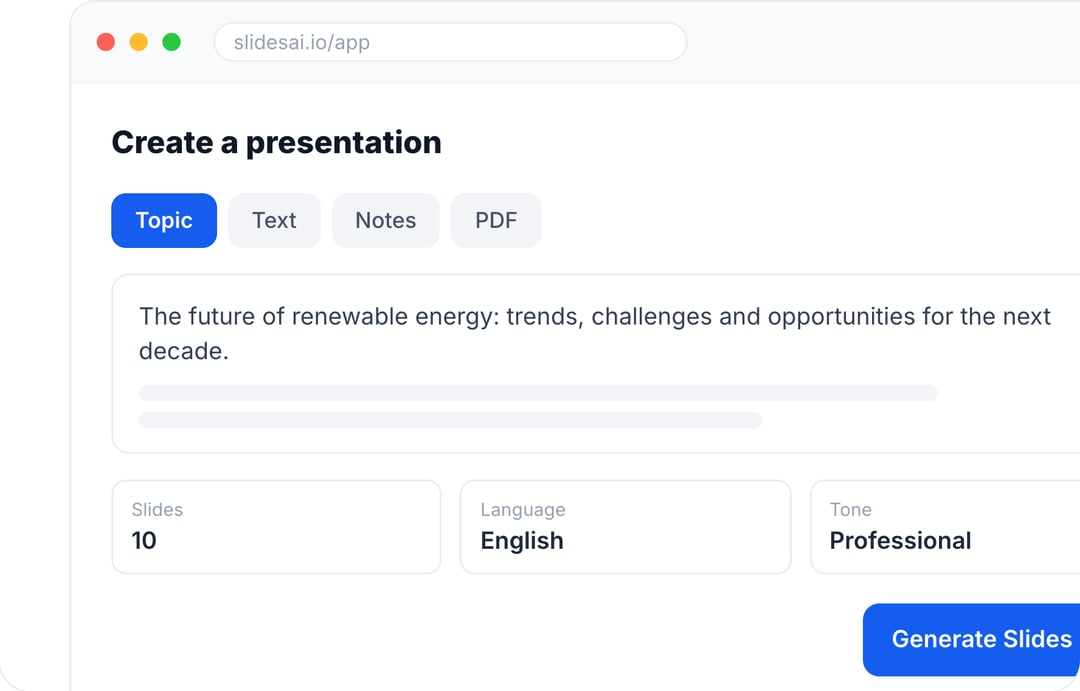
AI presentation makers like SlidesAI simplify the entire presentation workflow by turning ideas into polished slide decks in minutes. Compared to manual slide creation, which can take hours and requires design effort, AI-assisted workflows significantly reduce time to the first draft while improving visual consistency and collaboration. SlidesAI works best when you need quick turnarounds, clear structure, and professional templates without design friction. It can instantly generate slides from your topic, apply cohesive visual themes, and support real-time co-editing with teammates. Manual creation is still useful for cases that require deep customization or highly sensitive messaging.
Create Presentations in Minutes With SlidesAI
- Start with a topic, text, notes, or PDF
- Generate slides in minutes
- Customize your presentation with ease
Conclusion
Creating a persuasive presentation doesn’t have to be complicated. When you choose a topic that aligns passion with audience relevance and freshness, structure your message around a clear problem–solution–benefit flow, and support it with strong visuals and interaction, your ideas naturally become more convincing. With AI tools like SlidesAI, you can quickly transform those ideas into polished, professional decks, saving time while maintaining clarity, consistency, and impact.
Presentations come in all shapes and sizes — and so do the people giving them. Whether you’re brand new to public speaking or a seasoned presenter looking for fresh ideas, our blogs are designed to meet you right where you are. No matter your audience, goal, or time limit, you’ll find something worth presenting in the collection below.
- 250+ Best Presentation Topics from Different Categories & Useful Tips
- Best 5-Minute Presentation Ideas: Topics, Tips & How to Pick One
- 125+ Impromptu Presentation Topics for Students, Professionals, & More
- 400+ Funny PowerPoint Night Ideas to Steal The Show
- Best Science Topics for Students and Professionals
- Top Human Resource Presentation Topics for Modern Workplaces
- 10 Minute Presentation Ideas: Best Topics, Examples & Tips
Frequently Asked Questions
1. What is the best topic for a persuasive Presentation?
Choose a topic that aligns with your passion, audience interest, and credibility.
2. What are the examples of persuasive presentations?
Topics can range from AI ethics and climate change policies to school reforms and health and lifestyle trends.
3. What topic is best for a 5-minute speech?
Focus on narrow, high-impact issues, such as banning plastic straws or promoting daily mindfulness for a 5-minute talk.
4. What are some good persuasive presentation topics for college students?
Student-relevant topics include AI tools in learning, mental health support, or campus sustainability initiatives.
5. How do you choose a persuasive topic that your audience cares about?
Survey interests, check relevance, and anticipate objections to ensure engagement.
6. What persuasive topics work for a 10-minute presentation?
Moderately broad topics like renewable energy policies or workplace mental health work well for a 10-minute window.
7. What Topics resonate with U.S. workplace audiences?
Remote work policies, AI adoption, workplace diversity, and ethical business practices generally resonate with U.S. working people.
8. What is the difference between persuasive vs informative presentations?
A persuasive presentation motivates action. Informative presentation educates without urging a decision.
9. How can you structure a persuasive topic using problem-solution-benefit?
Start with a hook → define the problem → propose a solution → explain benefits → end with CTA.
10. What are the best ethics-related persuasive topics?
AI ethics, assisted dying, privacy rights, and corporate responsibility are some of the best persuasive presentation topics related to ethics and morality.
11. How can AI tools speed up persuasive deck creation?
AI automates slide generation, template application, and collaboration in minutes.
12. What are the best topics for interactive presentations?
Poll-heavy topics like social media habits, sustainability choices, or workplace policies are suitable topics for an interactive presentation.
13. What are the persuasive topics for mixed audiences?
Universal themes like health, technology, environment, and education work well for everyone.
14. How do I open my persuasive presentation to hook the room?
Start with a story, statistic, or thought-provoking question.
15. What is a simple structure for persuasion?
Hook → Problem → Solution → Benefits → CTA.
16. Do I need stats or stories to persuade better?
Yes, both enhance credibility (logos) and emotional connection (pathos).
17. What are the trending topics for 2026?
AI in education, climate sustainability, mental health, and digital privacy are some popular topics in 2026.
18. How to make a persuasive presentation interactive?
Use polls, quizzes, Q&A, and audience-driven discussions.
19. Is it okay to use AI to build persuasive slides?
Absolutely, as long as you review content for accuracy and context, AI can be very useful to build a persuasive presentation within minutes.